Search This Blog

CONTACT

Send Davina your news and comments blogger@somersetartworks.org.uk

4 February 2011

Get out there!

We interrupt your normal blogging for this important announcement:

Get your shoes on, get involved and get around here and out there with SAW!


Around Here and Out There - Free Intergenerational Coach Trip to Weston. This is an invitation to be part of a fun and interesting creative project in Langport all about our lives and stories, our public space and our environment. We’re inviting up to 30 people aged 25 and under, or aged 50 and over, to be part of this adventure.
For this SAW intergenerational art project we have organised a free coach trip for people (50+ or under 25) to see the Wonders of Weston (new public art in Weston-Super-Mare) on Saturday 05 March. This fun and informative tour will look at how art and design has impacted on public space and can help us to think about the future creative life of Langport.We are particularly keen to find grand parents and grand children that would like to come together.

This is a free event but obviously we have limited places so participants should book as soon as possible.

Please click on the link below which provides a pdf. document with further details on:

Thank you for listening.

Google a Gallery

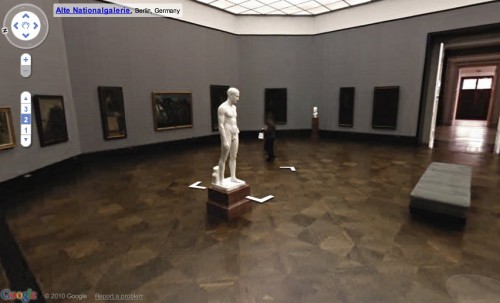
Wednesday the 2nd of February saw the launch of the website, Art Project from Google. Now for the first time people wondering around on google street view online can now also for the first time enter some of the great galleries such as New York's MOMA, The Van Gogh museum in Amsterdam and London's very own Tate Britain and National Gallery. You can virtually view from the comfort of your own home 385 rooms featuring over 1,000 works of art. All the works shown have been scanned in detail and viewers are allowed to 'interact' with the work on show posting their own comments and youtube videos in response to the work. It is certainly an interesting development especially in the way we as viewers view art works.

I was trying to decide where I stood on this new technology and what possibilities it may hold for the future. On one hand I can see it as a great way of engaging a potentially new audience of people, making artworks more accessible and promoting and encouraging debates and responding to work they see. Then on the other hand, I think and I'm sure that many would agree, that nothing beats seeing a painting/sculpture or any work of art in the flesh. You cannot truly appreciate the sublime, awe when confronted with a huge Barnett Newman, or the layers of brush marks on a Van Gogh, or the busy yet somehow still quiet-like reverence of being in the gallery spaces themselves. I also like the surprise element of going into a gallery for the first time, and not knowing if there will be a Francis Bacon, a Paula Rego, a Jeff Koons or a Rembrandt around the corner...The element of surprise is one of the fun things about going!

It is a similar dilemma that is met when people decide to choose an e-reader over an actual book, they are the same thing in content but different ways of experiencing them. Its a matter of preference. However, on the subject of books, I expect artists also had trepidation when first having their work reproduced in books, not matter how high quality the print its never the same as the real thing. To some extent that rounds my argument to a point where I can say that I think its a good thing art can be viewed online in this way, as after all what first got me interested in Roy Lichtenstein, Fernand Leger and Jim Dine was seeing their work in books, I then choose to seek out the real things. I would assume that the web would inspire other people who may be discovering new artists for the first time.

And what of the future? Will we be able to see whole exhibitions from smaller, commercial galleries online? In second life people already do host exhibitions? Why has no one ever had a virtual exhibition as a part of Somerset art weeks? Would anyone want to?? It would certainly be a very different kind of art and audience if someone chose to show their work solely online. In times or recession and with the struggles that are sometimes faced with finding arts venues is a virtual exhibition the way forward? I wonder...


Click on below link if you fancy a parooze around the Tate Britain:
http://www.googleartproject.com/museums/tate

20 January 2011

January's 'Art book of the month' : Seven days in the art world by Sarah Thornton

Once again, it is time for the art book of the month! When selecting the book for this month I have picked a book that I actually read quite a few months ago but it is one I keep coming back and referring to. Well, that and the fact that the vast majority of art books I have read recently seem to focus on chimpanzees and ideas to do with evolution, so I figured that this might be more entertaining!

Ok, so this book presents a contemporary look at the 'art world' as we know it today and not so much in seven days (as the title would suggest) but in seven different aspects that make up the collective of the art world. These seven situations are; art auctions, group critique's in university art courses, art fairs, art prizes (specifically the Turner Prize), art magazines, art studios and biennials. Each chapter looks at each specific area of the arts in which Thornton uses her own observation and experiences whilst speaking to the artists/curators/journalists/students etc. who inhabit those places. I found this makes the book a lot more witty and fun to read as it is told from the author's perspective into her enquiry into different art institutions. My only criticism is that despite the depth Thornton does go into within these seven areas there are still many more aspects of the art world left un-explored in this book, such as: site specific art, art therapy, commercial/non commercial galleries(Is there such a thing as a non-commercial gallery?), art groups and more.

What I particularly liked, however, and why I mentioned I keep going back to it, is because the chapter all about 'group crits' has so much resonance with my own past and present circumstances, I can relate to it much more than the chapter about art auctions for example. Anyway, Thornton spends the day observing in on the group crits of a class of Fine Art degree students in California as they discuss and question each others work. The result of her observations is nothing revolutionary, but it is somewhat really heartening and useful to see how group crits are viewed from a point of view other than your own. For example:
"Group crits offer a unique - some say "Utopian" -situation in which everyone focuses on the student's work with a mandate to understand it as deeply as possible. Crits can also be painful rituals that resemble cross-examinations in which artists are forced to rationalize their work and defend themselves from a flurry of half-baked opinions that leave them feeling torn apart. Either way, crits offer a striking contrast to the five second glance and shallow dollar values ascribed to works at auctions and fairs."
A lot of emphasis is put on the benefits of a 'shared' art practice either through arts groups, crits or teaching which, again may be nothing new to someone reading this book from an art background, but is none the less refreshing and pleasing to read.
She continues,
"Crits are performances in which the students aren't so much acting as searching for the public face of a real artistic "me."
I don't think you need to be a student studying art to relate to the above quote and it makes me think of the opportunities of 'pecha kuchas' that have been happening recently and how they could be used in the same way a crit is.
I digress, but would recommend the book for a read even for the chapter on group crits alone. Whether you're coming at this book from an art or non-art background its an enjoyable read. Artists would like it because they can relate to its various circumstances and characters found within it and anyone curious about the art world would enjoy it because it challenges the value and 'usefulness' (for want of a better word) of art today, particularly in reference to art fairs and auctions where art is arguably more of a commodity. Thornton even questions the value of arts prizes like the Turner Prize in providing exposure for artists and engaging the public. There's lots to be said.
Still, I think you'd need a lot more than seven days to really understand the art world, and would you really want to? How does a lifetime sound?